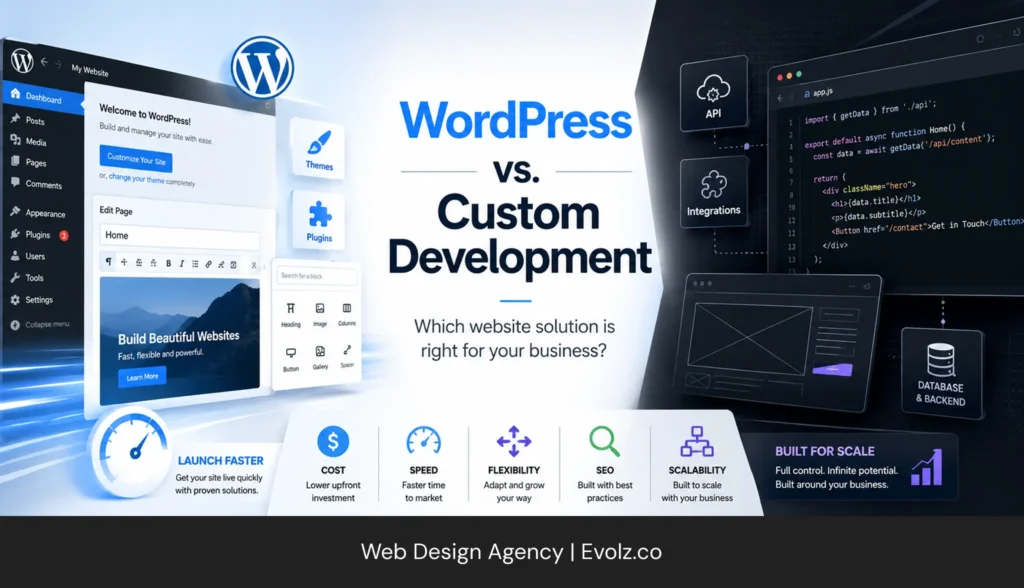
Every business eventually hits this fork in the road: build on WordPress, or invest in a fully custom website? It’s one of the most searched web development questions for a reason — the wrong choice can cost you months of rebuilding, or thousands of dollars in unnecessary custom code you never needed.
The honest answer is that neither platform is universally “better.” The right choice depends on your budget, your growth timeline, and how much control you actually need. Below is a straight, no-fluff comparison, plus the framework we use with our own clients to make this call in minutes, not weeks.
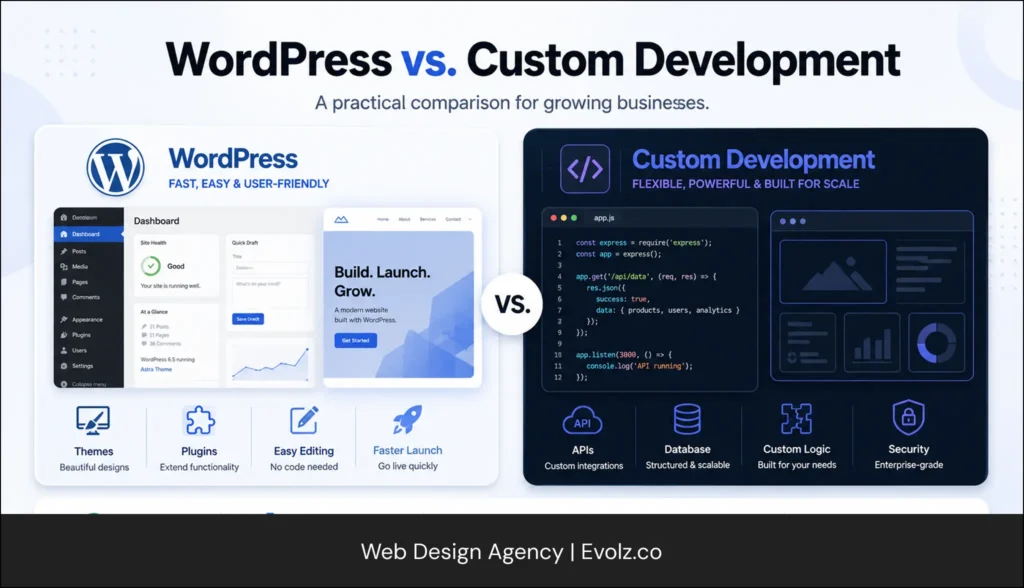
Quick Comparison: WordPress vs. Custom Development
| Factor | WordPress | Custom Development |
|---|---|---|
| Upfront cost | Low — mainly hosting, theme, and plugin costs | High — every feature is built from scratch |
| Time to launch | Days to a few weeks | Several weeks to a few months |
| Best for | Small to mid-size businesses, content-driven sites, standard e-commerce | Complex platforms, unique UX, heavy custom integrations |
| Customization | Flexible within theme/plugin limits | Unlimited — built around your exact spec |
| Performance | Good when optimized, but plugin-dependent | Typically faster out of the box — no unused code |
| SEO capability | Strong out of the box, extendable with plugins | Full technical control, but requires deliberate setup |
| Security | Requires regular updates; most vulnerabilities come from third-party plugins | Smaller attack surface, but no built-in patch ecosystem |
| Scalability | Handles moderate growth well with the right architecture | Built to scale from day one |
| Ongoing edits | Non-technical users can update content directly | Usually requires a developer for changes |
| Ownership feel | You control the dashboard | You depend more on your dev partner |
What Is WordPress Development?
WordPress is a content management system that powers a large share of the websites on the internet today. It works through themes and plugins, so a functional, professional-looking site can go live quickly without writing code from scratch. For businesses that need to launch fast, keep costs predictable, and want the ability to edit their own content without calling a developer every time, WordPress is usually the practical starting point.
What Is Custom Website Development?
Custom development means building your site’s frontend and backend from the ground up — no theme, no plugin stack, no inherited code you didn’t ask for. Every part of the site exists because it serves a specific purpose. This gives you complete control over speed, functionality, and design, but it comes with a real cost: more time, more budget, and more reliance on a developer for future changes.
Cost and Timeline: What to Actually Expect
WordPress sites are typically far cheaper to get live, since you’re paying for hosting, a theme, and any premium plugins rather than custom-built functionality. A straightforward WordPress build can go from kickoff to launch in a matter of days to a few weeks.
Custom builds cost significantly more upfront because there’s no template shortcut — design, frontend, and backend are all built specifically for your business. Timelines typically stretch from several weeks to a few months depending on scope. That cost buys you something WordPress can’t fully replicate: a site with zero unnecessary code and no ceiling on what it can eventually do.
The Factor Most Comparisons Skip: Total Cost of Ownership
Most comparisons stop at launch cost. But the real cost of a website plays out over years, not weeks:
- WordPress has a lower entry cost, but ongoing plugin licenses, security monitoring, and update maintenance add up — especially if the site isn’t set up correctly from the start.
- Custom sites have a higher entry cost, but fewer moving parts to maintain long-term, since there’s no third-party plugin ecosystem that can break with every update.
The right question isn’t “which is cheaper to build” — it’s “which is cheaper to own for the next three years, given how I plan to use this site.”
When to Choose WordPress
- You need to launch within weeks, not months
- Your budget is fixed and needs to go further
- Content will be updated frequently by non-technical staff
- Your site is primarily content-driven: blog, service pages, standard e-commerce
- You want access to a large plugin ecosystem for SEO, forms, and marketing tools
When to Choose Custom Development
- Your site needs deep integrations — booking systems, proprietary dashboards, complex logic
- You’re expecting high traffic or rapid scaling and can’t risk plugin bottlenecks
- Page speed is directly tied to conversions or ad spend efficiency
- Your brand needs a UI that simply doesn’t exist as a theme
- You’re building a long-term platform, not just a website
The Middle Path: Customized WordPress Development
Here’s what most comparisons miss: you rarely have to pick a pure extreme. A customized WordPress build — where a developer works past the default theme to hand-code specific templates, custom plugins, and performance optimization — gets you most of the flexibility of custom development at a fraction of the cost and timeline of building from zero.
This is where a lot of our own client work lives. We build fully custom when a project genuinely needs it, and we build heavily customized WordPress when that’s the smarter call for the business — not because one platform pays better, but because the goal is a site that performs, not a portfolio piece.
Real Client Examples
CleanFit: A dutch supplement brand on Shopify, Funnelish and different custom integrations needed a conversion-focused design, SEO overhaul and scalable infrastructure. [Link: CleanFit case study]
AStar Tuition: A landing page rebuilt around a Calendly booking flow to convert paid ad traffic more efficiently. [Link: AStar Tuition case study]
Both projects prove the same point: the platform is only ever a means to an end. The deciding factor was always the business goal — bookings, conversions, or brand credibility — not which CMS/Code based looked better on paper.
Frequently Asked Questions
Is WordPress good enough for a serious business website?
Yes, for the large majority of small and mid-size businesses. WordPress becomes a limitation only when your functionality needs outgrow what themes and plugins can reasonably support.
Is custom development always faster once it’s built?
Not automatically. A custom site can be just as fast — or faster — since there’s no unnecessary plugin code, but speed still depends on how well it’s built and hosted.
Can I switch from WordPress to custom development later?
Yes. Many businesses start on WordPress to validate their offer, then move to a custom build once traffic, complexity, or integrations justify the investment.
Does WordPress hurt my SEO compared to a custom site?
No — WordPress can perform very well for SEO with the right setup. Custom sites offer more granular technical control, but that only matters once you’re optimizing at an advanced level.
The Bottom Line
If you need to launch fast, keep costs predictable, and manage content yourself, WordPress is the smarter starting point. If your business depends on complex functionality, top-tier performance, or a brand experience no theme can deliver, custom development is worth the investment. And if you’re stuck in between, a customized WordPress build is very often the answer nobody mentions.
Not sure which path fits your business? Book a free strategy call and we’ll map out the right approach based on your goals, budget, and timeline — not which platform we’d rather sell you.